Eye Sight in the Squat
Where we focus our eye sight during the squat matters: as we squat, we want to look down and ahead -- approximately 8-12 feet in front of us. By doing so, initiating hip drive out of the hole is more easily accomplished. However, if we look straight ahead or gaze up toward the ceiling, many times we tend to lead with our chest because it follows where we focus. When our chest comes up first, our hips, and subsequently our knees, move slightly forward; this decreases our knee angle and results in reduced hamstring tension due to the relationship between our knee and hip joints. (Our hamstrings are a valuable prime mover in this exercise -- many people fail to recognize this), and when we lose even the slightest bit of elasticity, power is reduced. So the next time you set up for and execute the king of exercises, be sure to have the appropriate line of sight. Your gains will thank you!

Water Helps You Grow
The "pump," or the look of an expanded body after a voluminous lift, is a result of water being displaced from your blood to your muscles. This puffed-up appearance is actually a good thing. Why? Water is anabolic; or, more aptly stated, the lack of water can limit a building condition. That's right: H2O actually helps muscle grow! If you don't have enough of it in your system, build-up can be compromised. When you're in a dehydrated state, your body goes into preservation mode. (The body is pretty smart. It knows what to do to survive and thrive.) If water is not abundant, it does not adequately enter the muscle cells after a workout, and thus, it more so stays in the blood and surrounding areas. By limiting the entrance of water to the muscle cells, protein can be stripped and synthesis can be reduced. (We want to PROMOTE protein synthesis, not prohibit it.) So take that sip of water when you have the chance, and consume that extra drink from the fountain between sets.
Lactic Acid Is Your Friend
"Slow down! I have too much lactic acid built up in my legs, and I can't run any faster!" You've most likely heard this, or something similar to it at some point in your training career. And like most people, you probably accepted the notion that the L word limits performance. But is lactic acid really the bad guy? Is it the byproduct that inhibits what you can do on the track or in the gym? The answer appears to be no. Thanks to the work of George A. Brooks, professor of integrative biology at the University of California, Berkeley, the once-believed theory behind lactic acid and its accompanying workout inhibition has been debunked; in fact, a number of other researchers investigated Brooks' new-found theory, and they confirmed his findings. Could it be? Lactic acid is actually your friend? That seems to be the case. It has now been shown that lactic acid is a source of fuel, and it helps the body during bouts of exercise; without it, your training actually suffers. When you're performing an intense workout, your body, via the cell's mitochondria, takes up lactic acid and turns it into energy to help further drive performance. So what's the limiting factor that makes you slow down or stop performance? Hydrogen ions and a decrease in cellular pH, which increases bodily acidity. As the body heightens its level of work output, it simply cannot buffer the excess ions. This is the reason extended bouts of intense running or lifting suffers. So the next time you "feel the burn" which causes you to cease further effort, don't blame lactic acid; instead, thank lactic acid for giving you a little more time before the muscle fatigue sets in.
Deadlift Back Angle
Angles play an important role when weight training (geometry *did* come in handy after all!). Too little here or too much there and your body moves out of place; when your body is out of place, you can't lift as much weight, you can become injured, or you end up performing an entirely different exercise. The back angle -- which is formed by the torso and the floor -- is largely dictated by the opening and closing of the hips; as the hips open, so too does the back. In a properly executed deadlift, the back angle stays relatively horizontal during the early phase of the pull. As the bar approaches the knees, however, things begin to change; it's at this point that the hips really start to extend and the back starts to appear vertical. Why is this important? If the back -- which remains isometrically contracted throughout the lift -- appears too vertical too early, you're likely sitting back and down, which looks and feels more like a squat. You'll have a problem lifting the bar up and around your knees in this position. If the back appears too horizontal later in the lift, you've likely opened your knees entirely without much hip extension, which looks and feels more like a good morning. You'll have a problem keeping the bar close to the body and lifting it to the the final position. Seen below are approximate back angles at the various stages of the deadlift. When you pay attention to the details and allow your body to do what it's supposed to do, you'll likely become stronger while experiencing fewer injuries. (You'll perform the proper exercise, too!)

Traps and Deadlifts
Have you ever woken up with sore biceps after a day in which you moved? Thinking back upon the loading and unloading of heavy furniture, you recall your arms being at a 90-degree, locked (isometric) position in order to carry couches up and down stairs and throughout rooms. Although you weren't performing bicep curls with a repeated up and down motion, you were still demanding a lot of work from these muscles through prolonged, strenuous contraction.
(This is our long-winded intro to why deadlifting builds the traps...)
Do you want strong, well-developed traps? (Traps are the new abs. Why wouldn't you want them to be bigger and better?!) Then you must deadlift! Deadlifting arguably helps develop this 3-part muscle more than any other lift on the planet.
The traps, like the biceps in the above example, must operate in a similar manner during this lift. The large muscle group, through isometric contraction, must withstand large amounts of weight pulling down on it and transfer force from the lower back up through the shoulders. They are liken to a beam supporting a bridge. The accumulation of reps, sets, and weight mean greater work; greater work results in a larger, more well-developed support beam for the body -- bigger, better traps!
So the next time you're picking up hundreds of pounds from the floor, just remember, your upper body is doing just as much work as your lower body. The deadlift is a valuable strength- and muscle-building tool for the traps.

The Farmer Gym Way
Challenge yourself to our 16 parameters of fitness, and put your body to the 14-week strength and conditioning test... And see why The Farmer Gym Way has been flying off the Amazon shelves!
Week 1, Day 5 -- Testing Week:
(1) Maximum Overhead Press:
(2) 30-second Row for Distance:
(3) 7-minute of Burpees:
(4) 2-mile Run:
*The above example is one of the testing days where you'll set a personal baseline.

How Many Calories Do I Need?
How many calories should I consume in order to lose weight? What if I want to gain weight? You may have asked yourself these questions more than once. Luckily, there's an equation that can help guide you. The Mifflin-St Jeor method, the most recently constructed caloric-need formula, approximates the number of calories we need in order to lose, gain, or maintain weight.
Male BMR = 10 × weight (kg) + 6.25 × height (cm) – 5 × age + 5
Female BMR = 10 × weight (kg) + 6.25 × height (cm) – 5 × age – 161
* lb. / 2.2 = kg.
* in. x 2.54 = cm.
For example: John, 40 years old, weighs 95 kg. (209 lb. / 2.2), and has a height of 182.88 cm. (72 in. x 2.54). His BMR (Basal Metabolic Rate) -- the number of calories you would burn if you did nothing all day -- is 1,898. (950 + 1,143 - 200 + 5)
10 x 95 = 950
6.25 x 182.88 = 1,143
Now we need to adjust this number to account for activity. How do we do that? We multiply BMR by an approximate activity factor. The numbers are:
1.200 = sedentary (little or no exercise)
1.375 = light activity (light exercise / 1-3 days per week)
1.550 = moderate activity (moderate activity / 3-5 days per week)
1.725 = very active (hard exercise / 6-7 days per week)
1.900 = extra active (very hard exercise / every day and physical job)
John works out 6 times per week, and thus, is considered to be very active.
1,898 x 1.750 = 3,321.5
Therefore, according to Mifflin-St Jeor's formula, John needs to consume just over 3,321 calories per day to maintain his current weight. If John wants to lose approximately 1 lb. per week, he must restrict 3,500 calories a week (there are 3,500 in 1 lb. of weight); therefore, a good strategy would be to consume roughly 500 fewer calories per day (500 calories per day x 7 days per week). He would have to do the opposite to gain approximately 1 lb. per week.
It should be noted, the formula is not perfect, as every person is different due to metabolic demands.
Of course, if time is limited, you can always Google "caloric needs calculator".
Open Hips, Not Over Arch
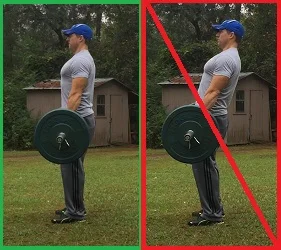
Finish the lift right; don't injure yourself! A common problem for many deadlifters occurs at the end of the exercise. Yes, we absolutely want to finish the lift by standing up with the weight; but, unfortunately, some people illustrate its completeness by over emphasizing "open hips." A finished deadlift happens when the body is in alignment, from head to heel, and the hips are open, without a present crease (the picture on the left). It's when people take the openness too far and arch their back excessively (the picture on the right). When we have too much of an arch, a few things can take place, both leading to possible injury: it can overload parts of the spine, and it has the potential to cause misalignment of the hips. So, instead of leaning back a few extra inches, know that once you're upright and you have open hips, the lift has been successfully executed!
Hand Placement on the Bench Press
The bench press is not only the most popular exercise in the weight room (just look around gym floors everywhere on a Monday), but it is also the most dangerous. With hundreds of pounds hovering overhead, it's absolutely vital that hand placement be properly administered. Above all else, do not -- we repeat, DO NOT -- use a thumb-less grip. Someone, somewhere, may have told you that "this will add pounds to your lift," but he or she obviously did not have your best interest in mind: your safety... Once your thumbs are securely wrapped around the bar, you can fully squeeze it, thus helping increase the lift's efficiency. By firmly gripping the weight, a more rigid system -- your hands and arms -- can be anchored to the barbell, and your ability to fire more motor neurons through your upper-torso and into your arms can best be achieved. When the bar is in the hands, it should not roll backward onto to the finders; this creates a mechanical disadvantage, as the bar is no longer over the bones of your forearms and is instead being supported by compromised wrists. When the bar is on the back of the palms (over the forearm bones), the greatest forced can be exerted. As you lift the weight, be sure to maintain a powerful grasp on the barbell so that it does not shift during your repetitions.

Bar Over Mid-Foot
To perform your best squat and deadlift, the bar must be placed over your mid-foot. Period. When it's too far forward, your weight goes toward your toes and you move forward. When it's back too far, your weight shifts away from mid-line and your torso leans toward the rear and becomes too upright. Either too far forward or too far back will result in diminished strength and a less-than-optimal lift. When the bar is directly over your mid-foot, balance is best maintained while force is maximally transferred. If you start the lift ahead of or behind this position, you must expend more energy than necessary to correct the position and get into proper placement. (Your chance of injury also increases when the bar is out of placement.) So be certain to start the lift -- decent for squat and ascent for deadlift -- with the bar directly over your mid-foot; and try to maintain this position throughout the exercise. By doing so, your chance to perform your best lift is ideal.

Foot Placement on the Squat
In order to optimally squat, we must make sure our feet are anchored to the ground correctly. When setting up this exercise, our feet should be approximately shoulder-width apart, with our toes pointed out at roughly 15-30 degrees. (Anatomical structure, mobility, and lift variation -- high-bar, low-bar, and front squat -- will largely dictate the angle of the toes.) By pointing the toes outward, we are creating a slightly wider base, while also allowing for greater external hip rotation. This lets up get back and sit down more easily; it can also activate our groin muscles -- the adductors -- more, aiding in the force placed through the floor. In addition to depth and added force, setting up for the squat in the manner listed helps with knee placement and movement, or lack-thereof. (We don't want the knees to buckle in! We want them shifted outward, like the toes.) Again, foot placement it relative to the individual, with several variables dictating optimal position. If you're able to safely execute the exercise with "your" position, great!
